


Six Problems In Creating Health Apps in 2026

15 min read
I've been in the health world for quite some time in various roles and have observed the move from desktop-based apps barely more sophisticated than Excel sheets to the complex device-driven, AI-enabled ecosystem of health products of today. I think we’re at another turning point where we really can use large language models to interpret messy data sets and provide users with real value.
What are the underlying problems that prevent health products from truly delivering on their promise?
Top problems in health tech
I've been in the health world for quite some time in various roles and have observed the move from desktop-based apps barely more sophisticated than Excel sheets to the complex device-driven, AI-enabled ecosystem of health products of today. I think we’re at another turning point where we really can use large language models to interpret messy data sets and provide users with real value. Yet, major problems remain that keep us from moving toward health apps that really are making a difference in people's lives.
These are a few problems that feel thorny enough to group together and talk about. They represent fundamental problems to the project of digitizing our health experience.
The problem of manual entry
Insight requires data, which often requires manual data entry, which is a poor user experience. How can we find patterns without pressuring the user to tell us everything? Do we just wait for the next wearable to come along to solve the problem for us?
Health apps are nothing without real-time data with which to inform decisions about our health. While studies that reference population averages are great, we need personal reference to decide what behavior changes are best suited for the present moment.
Personal data used to entirely require us to enter details, by text field, for every data point. We'd enter body weight, reps in the gym, how much water we drank, how we're feeling in the moment, how we slept, and so on. These days we have wearable devices that allow for some of this data to be extracted without us ever needing to enter it. We've got data on sleep, movement, blood oxygen. If we wear a CGM, we get glucose and insulin-related data.
Despite all this, a good majority of data today still requires manual entry, and this is incredibly cumbersome. We're burdening users to tell us what's going on even before we get to the why. The tedium of health apps is one of the reasons for attrition: it's just such a task logging periods, when you had medications, what you ate, what your mood is doing, and so on. How do we get great data automatically so we can skip the back-and-forth and just deliver the real promise of health apps?
Interpretation is traditionally up to the user
Charts and graphs often put the onus on the individual to understand and interpret their own data. How can we bridge the gap of understanding?
Health apps love a good graph. That sweet, sweet graph, that shows a week's worth of change, or a single number that should be indicative of some metric: sleep, wellness, healthspan, step count, hours slept. Graphs give the illusion of certainty, that we have everything we need to make a good decision (more on this from The Tyranny of Metrics if you're interested).
When we display a data source, we're making the information more comprehensible than pure numbers in a table: we display visually in graphs so we can use our eyes and brains to find patterns. This bar is higher than that one: ah, insight. This line was low for two weeks and all of a sudden, boom, it's high. This section of the pie is the smallest: ah, understanding. Thanks to our hunter-gatherer roots, we have the ability to visually find patterns quite quickly. Even if we do find a pattern, we have to extrapolate meaning entirely separately. What does it mean when my step count peaks in the middle of the week? What does it mean when my A1C has been trending down over months?
This problem is made all the more poignant when we're looking at more complex data sets, messier data without clear patterns, or data sources where the true driver of change isn't visible. Perhaps we're seeing stress data from heart rate or heart rate variability, but the real driver is a poor work relationship that's harder to quantify but keeps us up at night, impending layoffs, a sick grandmother you keep thinking about, an as-yet undiscovered tumor or cancerous growth, a low-grade infection. You get the idea.
How do we bridge the gap of data understanding, where we take raw signal, even good raw signal, and instead of just showing the user pretty pictures, we turn information into insight?
Wearables aren't great for data accuracy
Wearables aren’t awesome at true data accuracy because they sacrifice accuracy for convenience. Research supports this. What conclusions can we draw if we are only dealing with partially accurate data?
Again I think a lot of what we're seeing in the consumer health tech space is the illusion of certainty. An app shows us a number and for the most part we trust it. My Oura app says I got an 85% sleep score? Ok, that's a reflection of how the world actually is. My Apple Health app says I got 3,224 steps yesterday? Ok, this is a real record of what actually happened.
We take for granted that companies have created things that give us perfect accuracy, but this really isn't the case: multiple studies show large error bars around even base metrics, errors that get worse when these base data are used as the starting point for further calculations. The apps often don’t couch their conclusions in nuance either. Two examples to illustrate the point here:
You're using an app to take photos of a meal, which then use AI to estimate the contents of a plate of food. Let's pretend it tells you the plate has 14g fat, 54g carbs, and 34g protein. In actuality, it's off by 16% from the real number. This number of calories is used to provide an in-app value for how much you ate today, which is then used to make value judgments on how close to your targets you ended up. It’s also used to tell you how long it’s going to take to reach a goal, may influence streaks and real value judgments you place on yourself about how you’re doing in relation to your goals.
Another app uses a device accelerometer to tell you how you did on a run, which may influence whether you thought you hit a personal record on a difficulty hill-climb. Or they use GPS data to estimate how difficult a ride will be, so you pack only a certain amount of food and water, but the estimate was off…you get the idea.
Link:
https://pubmed.ncbi.nlm.nih.gov/39213525/
https://pubmed.ncbi.nlm.nih.gov/39080098/
https://pubmed.ncbi.nlm.nih.gov/40373042/
https://pubmed.ncbi.nlm.nih.gov/40199339/
We sacrifice data precision for convenience: the inverse problem of the above, where we force people to enter true-but-cumbersome data. Here, we accept convenience for accuracy. But, what conclusions can we really draw if we’re dealing with partially accurate data?
Good health is mostly not sexy. How do we motivate behavior without novelty?
Health is often a consequence of our daily behaviors. Behavior change is one of the largest problems to solve. How can we urge action, consistently, when consistency is often what leads to better health outcomes? Drinking a gallon of water a day is not sexy.
Sometimes, we draw the lesson from sports that achievement is the result of great performance over a finite period of time: we focus and strain and strive for 2 hours to win an elite soccer match. We study for a semester to achieve a good grade in a class. We design sprint to finish some beautiful interface. These efforts have an end date and time, which motivate us to apply ourselves. How hard could it be? I can suffer over a short period of time for something I really care about, even things I don’t care about.
Great health outcomes are not like this…health intervention requires moderate decisions that are mostly good, most of the time. This is the kind of behavior change that our monkey brains have a tough time with. It’s not flashy to drink water every day, or to be okay missing a workout one day and get right back to it. To track nutrition and body weight regularly to go to sleep earlier even when you don’t want to. We do better with imminent goals because of the goal gradient hypothesis, hyperbolic discounting, and myriad other documented reasons that show why we aren’t all perfect specimens of health.
Motivating behavior change is hard, made especially more difficult because there really is no end date to good health and good habit formation that might actually shift the tides of your risk of major health factors, cardiac events etc. How can we continually hold a users’ attention, helping them get on the wagon after they fall off? How can we allow for steady progress and holding attention without cheap gamification?
How do we deal with individualization?
Most research for health initiatives covers population averages, indeed most of social science attempts to define boundaries on how humans respond to stimuli. But, individuals vary in the extreme in response to stimuli, nutrition, body weight set points, energy levels, and more. Applying a single brush stroke to everyone leads to suggestions and conclusions that are factually inaccurate. As yet, AI has been unable to really leverage individualization without forcing the user to self-describe how they are different.
I remember when I was doing research on training responses to exercise. Studies generally show better and worse ways to train which filter suggestions for how to create training plans down to some defined framework of parameters to adjust. If you look closer at the studies, you can see that individual responses to this or that protocol were dramatically different. Like, one person might barely gain strength on some protocol and another person would gain +250% strength in a bicep curl over some 8 week period, for example.
The question here isn’t to account for genetic differences to training stimuli, it’s to realize that we’re all different, and that throws a very large wrench in your ability to predict how someone can respond to an intervention.
Some tiny fraction of people have an allergic response to a medical treatment, let’s say it’s 0.01% of people. Roughly 8 million people un the US take a blood thinner and some 0.01% of those experiencing some reaction is still 800 real, actual users. This problem only compounds with more medications, training and health interventions, and diets.
We’re all different, and yet, the promise of health platforms is truly personalized, truly individualized care. I think we’re nowhere close. Systems are only learning about us at a rudimentary level, far from the kind of second brain, omniscient systems thinker we’d need to have it create nutrition, sleep, and training programs for us. The more complex the data available, the more ways we can potentially combine it to find real correlations that might be pathways to true insight. How do we get there?
Unknown data sets
There might always be another data set, just out of reach, that's the real cause to other effects. Without it, we're just guessing at what's going on.
We can only attempt to draw correlations and conclusions based on known data. We might be collecting a lot of data but missing the critical piece that would really put a health finding in the clearest light. This happens all the time. A doctor is conversing with a patient about poor sleep only to learn with more probing that the afternoon matcha green tea Sarna has contains 125mg caffeine. A health app is examining mood and nutrition and sees a relationship between the two: every time a user has breakfast over a 4-week early pattern, mood noticeably increases. The missing piece of the data set is that the user eats breakfast at a local coffee shop where he always talks to the same barista. It’s the barista causing the mood change, not the breakfast.
Life is full of data sets we haven’t digitized, or don’t even know ourselves. Who knows what degree microplastics or gut biome are affecting other data sets, bedroom temperature, hourly hormonal fluctuations, and so on, have on our major health indicators?
It is the work of science to tease out cause and effect. But, when we make apps for users, we’re always going to be operating with a limited data set. How can we make the most of what we have while being honest with users and helpful at the same time?
Six Problems In Creating Health Apps in 2026
15 min read
I've been in the health world for quite some time in various roles and have observed the move from desktop-based apps barely more sophisticated than Excel sheets to the complex device-driven, AI-enabled ecosystem of health products of today. I think we’re at another turning point where we really can use large language models to interpret messy data sets and provide users with real value.
What are the underlying problems that prevent health products from truly delivering on their promise?
Top problems in health tech
I've been in the health world for quite some time in various roles and have observed the move from desktop-based apps barely more sophisticated than Excel sheets to the complex device-driven, AI-enabled ecosystem of health products of today. I think we’re at another turning point where we really can use large language models to interpret messy data sets and provide users with real value. Yet, major problems remain that keep us from moving toward health apps that really are making a difference in people's lives.
These are a few problems that feel thorny enough to group together and talk about. They represent fundamental problems to the project of digitizing our health experience.
The problem of manual entry
Insight requires data, which often requires manual data entry, which is a poor user experience. How can we find patterns without pressuring the user to tell us everything? Do we just wait for the next wearable to come along to solve the problem for us?
Health apps are nothing without real-time data with which to inform decisions about our health. While studies that reference population averages are great, we need personal reference to decide what behavior changes are best suited for the present moment.
Personal data used to entirely require us to enter details, by text field, for every data point. We'd enter body weight, reps in the gym, how much water we drank, how we're feeling in the moment, how we slept, and so on. These days we have wearable devices that allow for some of this data to be extracted without us ever needing to enter it. We've got data on sleep, movement, blood oxygen. If we wear a CGM, we get glucose and insulin-related data.
Despite all this, a good majority of data today still requires manual entry, and this is incredibly cumbersome. We're burdening users to tell us what's going on even before we get to the why. The tedium of health apps is one of the reasons for attrition: it's just such a task logging periods, when you had medications, what you ate, what your mood is doing, and so on. How do we get great data automatically so we can skip the back-and-forth and just deliver the real promise of health apps?
Interpretation is traditionally up to the user
Charts and graphs often put the onus on the individual to understand and interpret their own data. How can we bridge the gap of understanding?
Health apps love a good graph. That sweet, sweet graph, that shows a week's worth of change, or a single number that should be indicative of some metric: sleep, wellness, healthspan, step count, hours slept. Graphs give the illusion of certainty, that we have everything we need to make a good decision (more on this from The Tyranny of Metrics if you're interested).
When we display a data source, we're making the information more comprehensible than pure numbers in a table: we display visually in graphs so we can use our eyes and brains to find patterns. This bar is higher than that one: ah, insight. This line was low for two weeks and all of a sudden, boom, it's high. This section of the pie is the smallest: ah, understanding. Thanks to our hunter-gatherer roots, we have the ability to visually find patterns quite quickly. Even if we do find a pattern, we have to extrapolate meaning entirely separately. What does it mean when my step count peaks in the middle of the week? What does it mean when my A1C has been trending down over months?
This problem is made all the more poignant when we're looking at more complex data sets, messier data without clear patterns, or data sources where the true driver of change isn't visible. Perhaps we're seeing stress data from heart rate or heart rate variability, but the real driver is a poor work relationship that's harder to quantify but keeps us up at night, impending layoffs, a sick grandmother you keep thinking about, an as-yet undiscovered tumor or cancerous growth, a low-grade infection. You get the idea.
How do we bridge the gap of data understanding, where we take raw signal, even good raw signal, and instead of just showing the user pretty pictures, we turn information into insight?
Wearables aren't great for data accuracy
Wearables aren’t awesome at true data accuracy because they sacrifice accuracy for convenience. Research supports this. What conclusions can we draw if we are only dealing with partially accurate data?
Again I think a lot of what we're seeing in the consumer health tech space is the illusion of certainty. An app shows us a number and for the most part we trust it. My Oura app says I got an 85% sleep score? Ok, that's a reflection of how the world actually is. My Apple Health app says I got 3,224 steps yesterday? Ok, this is a real record of what actually happened.
We take for granted that companies have created things that give us perfect accuracy, but this really isn't the case: multiple studies show large error bars around even base metrics, errors that get worse when these base data are used as the starting point for further calculations. The apps often don’t couch their conclusions in nuance either. Two examples to illustrate the point here:
You're using an app to take photos of a meal, which then use AI to estimate the contents of a plate of food. Let's pretend it tells you the plate has 14g fat, 54g carbs, and 34g protein. In actuality, it's off by 16% from the real number. This number of calories is used to provide an in-app value for how much you ate today, which is then used to make value judgments on how close to your targets you ended up. It’s also used to tell you how long it’s going to take to reach a goal, may influence streaks and real value judgments you place on yourself about how you’re doing in relation to your goals.
Another app uses a device accelerometer to tell you how you did on a run, which may influence whether you thought you hit a personal record on a difficulty hill-climb. Or they use GPS data to estimate how difficult a ride will be, so you pack only a certain amount of food and water, but the estimate was off…you get the idea.
Link:
https://pubmed.ncbi.nlm.nih.gov/39213525/
https://pubmed.ncbi.nlm.nih.gov/39080098/
https://pubmed.ncbi.nlm.nih.gov/40373042/
https://pubmed.ncbi.nlm.nih.gov/40199339/
We sacrifice data precision for convenience: the inverse problem of the above, where we force people to enter true-but-cumbersome data. Here, we accept convenience for accuracy. But, what conclusions can we really draw if we’re dealing with partially accurate data?
Good health is mostly not sexy. How do we motivate behavior without novelty?
Health is often a consequence of our daily behaviors. Behavior change is one of the largest problems to solve. How can we urge action, consistently, when consistency is often what leads to better health outcomes? Drinking a gallon of water a day is not sexy.
Sometimes, we draw the lesson from sports that achievement is the result of great performance over a finite period of time: we focus and strain and strive for 2 hours to win an elite soccer match. We study for a semester to achieve a good grade in a class. We design sprint to finish some beautiful interface. These efforts have an end date and time, which motivate us to apply ourselves. How hard could it be? I can suffer over a short period of time for something I really care about, even things I don’t care about.
Great health outcomes are not like this…health intervention requires moderate decisions that are mostly good, most of the time. This is the kind of behavior change that our monkey brains have a tough time with. It’s not flashy to drink water every day, or to be okay missing a workout one day and get right back to it. To track nutrition and body weight regularly to go to sleep earlier even when you don’t want to. We do better with imminent goals because of the goal gradient hypothesis, hyperbolic discounting, and myriad other documented reasons that show why we aren’t all perfect specimens of health.
Motivating behavior change is hard, made especially more difficult because there really is no end date to good health and good habit formation that might actually shift the tides of your risk of major health factors, cardiac events etc. How can we continually hold a users’ attention, helping them get on the wagon after they fall off? How can we allow for steady progress and holding attention without cheap gamification?
How do we deal with individualization?
Most research for health initiatives covers population averages, indeed most of social science attempts to define boundaries on how humans respond to stimuli. But, individuals vary in the extreme in response to stimuli, nutrition, body weight set points, energy levels, and more. Applying a single brush stroke to everyone leads to suggestions and conclusions that are factually inaccurate. As yet, AI has been unable to really leverage individualization without forcing the user to self-describe how they are different.
I remember when I was doing research on training responses to exercise. Studies generally show better and worse ways to train which filter suggestions for how to create training plans down to some defined framework of parameters to adjust. If you look closer at the studies, you can see that individual responses to this or that protocol were dramatically different. Like, one person might barely gain strength on some protocol and another person would gain +250% strength in a bicep curl over some 8 week period, for example.
The question here isn’t to account for genetic differences to training stimuli, it’s to realize that we’re all different, and that throws a very large wrench in your ability to predict how someone can respond to an intervention.
Some tiny fraction of people have an allergic response to a medical treatment, let’s say it’s 0.01% of people. Roughly 8 million people un the US take a blood thinner and some 0.01% of those experiencing some reaction is still 800 real, actual users. This problem only compounds with more medications, training and health interventions, and diets.
We’re all different, and yet, the promise of health platforms is truly personalized, truly individualized care. I think we’re nowhere close. Systems are only learning about us at a rudimentary level, far from the kind of second brain, omniscient systems thinker we’d need to have it create nutrition, sleep, and training programs for us. The more complex the data available, the more ways we can potentially combine it to find real correlations that might be pathways to true insight. How do we get there?
Unknown data sets
There might always be another data set, just out of reach, that's the real cause to other effects. Without it, we're just guessing at what's going on.
We can only attempt to draw correlations and conclusions based on known data. We might be collecting a lot of data but missing the critical piece that would really put a health finding in the clearest light. This happens all the time. A doctor is conversing with a patient about poor sleep only to learn with more probing that the afternoon matcha green tea Sarna has contains 125mg caffeine. A health app is examining mood and nutrition and sees a relationship between the two: every time a user has breakfast over a 4-week early pattern, mood noticeably increases. The missing piece of the data set is that the user eats breakfast at a local coffee shop where he always talks to the same barista. It’s the barista causing the mood change, not the breakfast.
Life is full of data sets we haven’t digitized, or don’t even know ourselves. Who knows what degree microplastics or gut biome are affecting other data sets, bedroom temperature, hourly hormonal fluctuations, and so on, have on our major health indicators?
It is the work of science to tease out cause and effect. But, when we make apps for users, we’re always going to be operating with a limited data set. How can we make the most of what we have while being honest with users and helpful at the same time?
Six Problems In Creating Health Apps in 2026
15 min read
I've been in the health world for quite some time in various roles and have observed the move from desktop-based apps barely more sophisticated than Excel sheets to the complex device-driven, AI-enabled ecosystem of health products of today. I think we’re at another turning point where we really can use large language models to interpret messy data sets and provide users with real value.
What are the underlying problems that prevent health products from truly delivering on their promise?
Top problems in health tech
I've been in the health world for quite some time in various roles and have observed the move from desktop-based apps barely more sophisticated than Excel sheets to the complex device-driven, AI-enabled ecosystem of health products of today. I think we’re at another turning point where we really can use large language models to interpret messy data sets and provide users with real value. Yet, major problems remain that keep us from moving toward health apps that really are making a difference in people's lives.
These are a few problems that feel thorny enough to group together and talk about. They represent fundamental problems to the project of digitizing our health experience.
The problem of manual entry
Insight requires data, which often requires manual data entry, which is a poor user experience. How can we find patterns without pressuring the user to tell us everything? Do we just wait for the next wearable to come along to solve the problem for us?
Health apps are nothing without real-time data with which to inform decisions about our health. While studies that reference population averages are great, we need personal reference to decide what behavior changes are best suited for the present moment.
Personal data used to entirely require us to enter details, by text field, for every data point. We'd enter body weight, reps in the gym, how much water we drank, how we're feeling in the moment, how we slept, and so on. These days we have wearable devices that allow for some of this data to be extracted without us ever needing to enter it. We've got data on sleep, movement, blood oxygen. If we wear a CGM, we get glucose and insulin-related data.
Despite all this, a good majority of data today still requires manual entry, and this is incredibly cumbersome. We're burdening users to tell us what's going on even before we get to the why. The tedium of health apps is one of the reasons for attrition: it's just such a task logging periods, when you had medications, what you ate, what your mood is doing, and so on. How do we get great data automatically so we can skip the back-and-forth and just deliver the real promise of health apps?
Interpretation is traditionally up to the user
Charts and graphs often put the onus on the individual to understand and interpret their own data. How can we bridge the gap of understanding?
Health apps love a good graph. That sweet, sweet graph, that shows a week's worth of change, or a single number that should be indicative of some metric: sleep, wellness, healthspan, step count, hours slept. Graphs give the illusion of certainty, that we have everything we need to make a good decision (more on this from The Tyranny of Metrics if you're interested).
When we display a data source, we're making the information more comprehensible than pure numbers in a table: we display visually in graphs so we can use our eyes and brains to find patterns. This bar is higher than that one: ah, insight. This line was low for two weeks and all of a sudden, boom, it's high. This section of the pie is the smallest: ah, understanding. Thanks to our hunter-gatherer roots, we have the ability to visually find patterns quite quickly. Even if we do find a pattern, we have to extrapolate meaning entirely separately. What does it mean when my step count peaks in the middle of the week? What does it mean when my A1C has been trending down over months?
This problem is made all the more poignant when we're looking at more complex data sets, messier data without clear patterns, or data sources where the true driver of change isn't visible. Perhaps we're seeing stress data from heart rate or heart rate variability, but the real driver is a poor work relationship that's harder to quantify but keeps us up at night, impending layoffs, a sick grandmother you keep thinking about, an as-yet undiscovered tumor or cancerous growth, a low-grade infection. You get the idea.
How do we bridge the gap of data understanding, where we take raw signal, even good raw signal, and instead of just showing the user pretty pictures, we turn information into insight?
Wearables aren't great for data accuracy
Wearables aren’t awesome at true data accuracy because they sacrifice accuracy for convenience. Research supports this. What conclusions can we draw if we are only dealing with partially accurate data?
Again I think a lot of what we're seeing in the consumer health tech space is the illusion of certainty. An app shows us a number and for the most part we trust it. My Oura app says I got an 85% sleep score? Ok, that's a reflection of how the world actually is. My Apple Health app says I got 3,224 steps yesterday? Ok, this is a real record of what actually happened.
We take for granted that companies have created things that give us perfect accuracy, but this really isn't the case: multiple studies show large error bars around even base metrics, errors that get worse when these base data are used as the starting point for further calculations. The apps often don’t couch their conclusions in nuance either. Two examples to illustrate the point here:
You're using an app to take photos of a meal, which then use AI to estimate the contents of a plate of food. Let's pretend it tells you the plate has 14g fat, 54g carbs, and 34g protein. In actuality, it's off by 16% from the real number. This number of calories is used to provide an in-app value for how much you ate today, which is then used to make value judgments on how close to your targets you ended up. It’s also used to tell you how long it’s going to take to reach a goal, may influence streaks and real value judgments you place on yourself about how you’re doing in relation to your goals.
Another app uses a device accelerometer to tell you how you did on a run, which may influence whether you thought you hit a personal record on a difficulty hill-climb. Or they use GPS data to estimate how difficult a ride will be, so you pack only a certain amount of food and water, but the estimate was off…you get the idea.
Link:
https://pubmed.ncbi.nlm.nih.gov/39213525/
https://pubmed.ncbi.nlm.nih.gov/39080098/
https://pubmed.ncbi.nlm.nih.gov/40373042/
https://pubmed.ncbi.nlm.nih.gov/40199339/
We sacrifice data precision for convenience: the inverse problem of the above, where we force people to enter true-but-cumbersome data. Here, we accept convenience for accuracy. But, what conclusions can we really draw if we’re dealing with partially accurate data?
Good health is mostly not sexy. How do we motivate behavior without novelty?
Health is often a consequence of our daily behaviors. Behavior change is one of the largest problems to solve. How can we urge action, consistently, when consistency is often what leads to better health outcomes? Drinking a gallon of water a day is not sexy.
Sometimes, we draw the lesson from sports that achievement is the result of great performance over a finite period of time: we focus and strain and strive for 2 hours to win an elite soccer match. We study for a semester to achieve a good grade in a class. We design sprint to finish some beautiful interface. These efforts have an end date and time, which motivate us to apply ourselves. How hard could it be? I can suffer over a short period of time for something I really care about, even things I don’t care about.
Great health outcomes are not like this…health intervention requires moderate decisions that are mostly good, most of the time. This is the kind of behavior change that our monkey brains have a tough time with. It’s not flashy to drink water every day, or to be okay missing a workout one day and get right back to it. To track nutrition and body weight regularly to go to sleep earlier even when you don’t want to. We do better with imminent goals because of the goal gradient hypothesis, hyperbolic discounting, and myriad other documented reasons that show why we aren’t all perfect specimens of health.
Motivating behavior change is hard, made especially more difficult because there really is no end date to good health and good habit formation that might actually shift the tides of your risk of major health factors, cardiac events etc. How can we continually hold a users’ attention, helping them get on the wagon after they fall off? How can we allow for steady progress and holding attention without cheap gamification?
How do we deal with individualization?
Most research for health initiatives covers population averages, indeed most of social science attempts to define boundaries on how humans respond to stimuli. But, individuals vary in the extreme in response to stimuli, nutrition, body weight set points, energy levels, and more. Applying a single brush stroke to everyone leads to suggestions and conclusions that are factually inaccurate. As yet, AI has been unable to really leverage individualization without forcing the user to self-describe how they are different.
I remember when I was doing research on training responses to exercise. Studies generally show better and worse ways to train which filter suggestions for how to create training plans down to some defined framework of parameters to adjust. If you look closer at the studies, you can see that individual responses to this or that protocol were dramatically different. Like, one person might barely gain strength on some protocol and another person would gain +250% strength in a bicep curl over some 8 week period, for example.
The question here isn’t to account for genetic differences to training stimuli, it’s to realize that we’re all different, and that throws a very large wrench in your ability to predict how someone can respond to an intervention.
Some tiny fraction of people have an allergic response to a medical treatment, let’s say it’s 0.01% of people. Roughly 8 million people un the US take a blood thinner and some 0.01% of those experiencing some reaction is still 800 real, actual users. This problem only compounds with more medications, training and health interventions, and diets.
We’re all different, and yet, the promise of health platforms is truly personalized, truly individualized care. I think we’re nowhere close. Systems are only learning about us at a rudimentary level, far from the kind of second brain, omniscient systems thinker we’d need to have it create nutrition, sleep, and training programs for us. The more complex the data available, the more ways we can potentially combine it to find real correlations that might be pathways to true insight. How do we get there?
Unknown data sets
There might always be another data set, just out of reach, that's the real cause to other effects. Without it, we're just guessing at what's going on.
We can only attempt to draw correlations and conclusions based on known data. We might be collecting a lot of data but missing the critical piece that would really put a health finding in the clearest light. This happens all the time. A doctor is conversing with a patient about poor sleep only to learn with more probing that the afternoon matcha green tea Sarna has contains 125mg caffeine. A health app is examining mood and nutrition and sees a relationship between the two: every time a user has breakfast over a 4-week early pattern, mood noticeably increases. The missing piece of the data set is that the user eats breakfast at a local coffee shop where he always talks to the same barista. It’s the barista causing the mood change, not the breakfast.
Life is full of data sets we haven’t digitized, or don’t even know ourselves. Who knows what degree microplastics or gut biome are affecting other data sets, bedroom temperature, hourly hormonal fluctuations, and so on, have on our major health indicators?
It is the work of science to tease out cause and effect. But, when we make apps for users, we’re always going to be operating with a limited data set. How can we make the most of what we have while being honest with users and helpful at the same time?

Flourishing
5 min read
Being user-centric or human-first isn't just to employ user research in design decisions.
Being user-centric or human-first isn't just to employ user research in design decisions.
These days, most experiences we have are mediated by technology that product designers and design teams have had their hands on. With the immense role the apps, websites, and operating systems play in our lives,
Is an app a tool? Should it make you feel happy? Should it use up as little time as possible in your day, so that you can focus on other things?
worry that true human fluorishing that's more than short term reward is undervalued in the everyday apps we use, the foundation of our world.
It's too easy to believe that an app is a tool, and unburden oneself from the rich experiences,
What happens when what users want and what's good for them are misaligned? While people often want what's good for them, it's not always the case.
What is it like to wonder without the ability to find a readily available answer?
What is it like to have time that isn't filled by things, where you just are?
What is it like when things are not efficient? What happens when the happy path is the non-optimized, rambling, confused journey.
How can designers be user-centric if they are unwilling to confront businesses with research that doesn't align with human fluorishing?
The value of philosophy and psychology in guiding our way forward.
Human-first as serving humans.
Long term interests versus short term outcomes.
What if we continue looking for ways to counter our deeply held negative human tendencies
Unintended but known consequences of good design:
It's easier to apply to jobs than ever on LinkedIn, so businesses are flooded with hundreds of applicants per position
We've centralized search, but changes in the algorithm can destroy entire businesses
Good reviews and virality can bring so much business to a restaurant that they're forced to close down
Algorithmic social content and the infinite scroll while away hours of people's lives every day.
AI is actively solving some of the world's most pressing problems, but automating away jobs in the process.
Thanks to Slack, Teams and more, it's easier than ever to work remotely, but we lose a sense of community in the process.
AI design tools open up new possibilities, but we no longer need practice on the fundamentals of design.
For users, what they want in the short term may conflict with what they want in the long term (impulse buys, hours scrolling, immediate notifications)
I don't want to design for addiction or marketing, which feels like manipulation. How can designers justify that?
As product designers, is the aim to design what users want or what they need? What users want, or what companies themselves want to change their bottom line?
Designers have no power if they can simply be replaced
Flourishing
5 min read
Being user-centric or human-first isn't just to employ user research in design decisions.
Being user-centric or human-first isn't just to employ user research in design decisions.
These days, most experiences we have are mediated by technology that product designers and design teams have had their hands on. With the immense role the apps, websites, and operating systems play in our lives,
Is an app a tool? Should it make you feel happy? Should it use up as little time as possible in your day, so that you can focus on other things?
worry that true human fluorishing that's more than short term reward is undervalued in the everyday apps we use, the foundation of our world.
It's too easy to believe that an app is a tool, and unburden oneself from the rich experiences,
What happens when what users want and what's good for them are misaligned? While people often want what's good for them, it's not always the case.
What is it like to wonder without the ability to find a readily available answer?
What is it like to have time that isn't filled by things, where you just are?
What is it like when things are not efficient? What happens when the happy path is the non-optimized, rambling, confused journey.
How can designers be user-centric if they are unwilling to confront businesses with research that doesn't align with human fluorishing?
The value of philosophy and psychology in guiding our way forward.
Human-first as serving humans.
Long term interests versus short term outcomes.
What if we continue looking for ways to counter our deeply held negative human tendencies
Unintended but known consequences of good design:
It's easier to apply to jobs than ever on LinkedIn, so businesses are flooded with hundreds of applicants per position
We've centralized search, but changes in the algorithm can destroy entire businesses
Good reviews and virality can bring so much business to a restaurant that they're forced to close down
Algorithmic social content and the infinite scroll while away hours of people's lives every day.
AI is actively solving some of the world's most pressing problems, but automating away jobs in the process.
Thanks to Slack, Teams and more, it's easier than ever to work remotely, but we lose a sense of community in the process.
AI design tools open up new possibilities, but we no longer need practice on the fundamentals of design.
For users, what they want in the short term may conflict with what they want in the long term (impulse buys, hours scrolling, immediate notifications)
I don't want to design for addiction or marketing, which feels like manipulation. How can designers justify that?
As product designers, is the aim to design what users want or what they need? What users want, or what companies themselves want to change their bottom line?
Designers have no power if they can simply be replaced

Social Media
5 min read
I’ve been grapping with social media and what to do with it for nearly as long as I’ve been using it, which is to say, since the early days of thefacebook.com, even livejournal before that. Before that, it was forums on bodybuilding.com, the Immortality Institute, Brainmeta.
The arguments for not using social media are known, and they are many. It’s the sensationalism, the rose-colored view of the world, the comparison, the numbers, the effects on attention, mood, FOMO, one’s social circle. It’s being sold to, not having control over what you see, the cost of the time that using social media replaces. It can be passive, we’re at the whim of shifting algorithms. Siloing, lacking balanced views, on and on.
For all this, and I swear I’ve been ready to pull the plug on a few occasions, I’ve seen some good as well. I was an unintentional “influencer” in the powerlifting world. My ability to squat, bench press, and deadlift heavy loads and talking about my experience, plus a few chance encounters with some very internet-famous people meant that at my peak, I had some 62,000 followers in Instagram. I wasn’t trying to grow my account, but I’m so sure that maintaining an account and the interactions therein had lasting effects on who I am as a person.
I have ADHD and I’m sure that the effects of social media are different on me than they might be with someone with different brain chemistry, better able to regulate motivation, time spent doing activities and the other cascading consequences of that particular disorder. That said, I think even healthy, well-meaning children and adults are failing to regulate themselves on these platforms.
I don’t want to speak about ill intentions from the people running these platforms, because I think sometimes it’s just a person trying to do their job better. Boss asks me to increase engagement? I got that. Boss says make people really enjoy the platform? I’ll do everything I can to maximize their experience on the platform: serve them perfectly curated content, the best comments, the best suggested posts, new features, make you feel like a star.
The reason I just can’t come to a conclusion is mainly that I’ve made some amazing friendships that seem forever linked to the platforms. As a result of all of this exposure and putting myself out there, I’ve had a chance to do powerlifting seminars in the UK, Canada, Sweden, Switzerland, Thailand, Dubai. I’m not bragging here, I’m just speaking to the power of connection here. The ability to share a slice of who I am, even if most of the time I never actually feel seen.
It feels like a resource, maybe? It feels like I shouldn’t throw away this thing that lets me connect to all of these people, currently some 52,000 or so followers. It’s like “damn, someone would have paid a lot of money to have something like this”.
So I’m stuck between wanting to burn my accounts to the ground for the times when I’m (still) sitting watching some sunset and thinking “this would make a good background for an Instagram story” or minding my own business working on a computer and, like a compulsive tic, Command + T +inst +Return and I’m looking at Instagram, even though I just did this same thing 20 minutes ago. It’s not even that I want to scroll or that content comes around so fast I need to absorb more of it. It’s just the habit.
The other day, I finished Careless People, the firsthand account of life at the very top of Facebook and the real world consequences of social media. I was the closest I’d ever been to deleting the platforms. I made a list of pros and cons, I re-read Jaron Lanier’s 12 reasons to delete your social media accounts right now, and I was pretty damn close.
It’s the people…I really think I’d miss knowing that I could contact a few people if I wanted to, and I dont think the connection would last the move to other methods of communication. That’s mostly on me…I’m terrible at regular communication. These days, I keep Instagram and Facebook off my phone, but I still feel like I’m kind of connected to them.
It’s partly that I have to be, but partly that I just don’t want to lose this thing that defined such a big part of my life. It would feel like a death, in a way.
Much of the talk around social media and how to think about those platforms has been to treat them like real places. I think that’s a metaphor that has legs. What is the place like where we meet these people, what would it be like to avoid going there ever again?
Anyway, I just wanted to express how conscious of a decision this has turned out to be, how carefully weighed. I’m trying to be the kind of person who navigates the world benevolently and make decisions that aren’t just good for my friendships, my entertainment, my career. I want to make decisions that are good for my brain, my heart. It’s honestly hard and I hate that it’s nuanced, that I might never feel settled before saying “ok yeah, that was the last straw.”
As I fall further away from powerlifting, I suspect the decision will become easier. Already, the bonds of these people on the platforms are weakening as I’m not posting, not looking to educate or market myself. The people I thought would be worried about what I’m up to, about who I am turning out to be as a person…it’s just not happening. I think I’d do the same thing if someone in my social circle dropped off. There’s been a very few times that I’ve messages a person I hadn’t heard from in a while. So I think, I’m not that special. People are out there just living their lives, stumbling, trying their best, succeeding, and showing only the juicy golden bits online.
How cynical!
And another part of me thinks, “I’m in tech, so of course I have to keep using social media, of course I need to stay up on the latest”
Perhaps this is all just a giant case of the sunk cost fallacy, but for now I’m going to keep circling this middle ground of barren desert and lush forest, unable to decide which is the path forward. Just wanted to get this out there today.
Social Media
5 min read
I’ve been grapping with social media and what to do with it for nearly as long as I’ve been using it, which is to say, since the early days of thefacebook.com, even livejournal before that. Before that, it was forums on bodybuilding.com, the Immortality Institute, Brainmeta.
The arguments for not using social media are known, and they are many. It’s the sensationalism, the rose-colored view of the world, the comparison, the numbers, the effects on attention, mood, FOMO, one’s social circle. It’s being sold to, not having control over what you see, the cost of the time that using social media replaces. It can be passive, we’re at the whim of shifting algorithms. Siloing, lacking balanced views, on and on.
For all this, and I swear I’ve been ready to pull the plug on a few occasions, I’ve seen some good as well. I was an unintentional “influencer” in the powerlifting world. My ability to squat, bench press, and deadlift heavy loads and talking about my experience, plus a few chance encounters with some very internet-famous people meant that at my peak, I had some 62,000 followers in Instagram. I wasn’t trying to grow my account, but I’m so sure that maintaining an account and the interactions therein had lasting effects on who I am as a person.
I have ADHD and I’m sure that the effects of social media are different on me than they might be with someone with different brain chemistry, better able to regulate motivation, time spent doing activities and the other cascading consequences of that particular disorder. That said, I think even healthy, well-meaning children and adults are failing to regulate themselves on these platforms.
I don’t want to speak about ill intentions from the people running these platforms, because I think sometimes it’s just a person trying to do their job better. Boss asks me to increase engagement? I got that. Boss says make people really enjoy the platform? I’ll do everything I can to maximize their experience on the platform: serve them perfectly curated content, the best comments, the best suggested posts, new features, make you feel like a star.
The reason I just can’t come to a conclusion is mainly that I’ve made some amazing friendships that seem forever linked to the platforms. As a result of all of this exposure and putting myself out there, I’ve had a chance to do powerlifting seminars in the UK, Canada, Sweden, Switzerland, Thailand, Dubai. I’m not bragging here, I’m just speaking to the power of connection here. The ability to share a slice of who I am, even if most of the time I never actually feel seen.
It feels like a resource, maybe? It feels like I shouldn’t throw away this thing that lets me connect to all of these people, currently some 52,000 or so followers. It’s like “damn, someone would have paid a lot of money to have something like this”.
So I’m stuck between wanting to burn my accounts to the ground for the times when I’m (still) sitting watching some sunset and thinking “this would make a good background for an Instagram story” or minding my own business working on a computer and, like a compulsive tic, Command + T +inst +Return and I’m looking at Instagram, even though I just did this same thing 20 minutes ago. It’s not even that I want to scroll or that content comes around so fast I need to absorb more of it. It’s just the habit.
The other day, I finished Careless People, the firsthand account of life at the very top of Facebook and the real world consequences of social media. I was the closest I’d ever been to deleting the platforms. I made a list of pros and cons, I re-read Jaron Lanier’s 12 reasons to delete your social media accounts right now, and I was pretty damn close.
It’s the people…I really think I’d miss knowing that I could contact a few people if I wanted to, and I dont think the connection would last the move to other methods of communication. That’s mostly on me…I’m terrible at regular communication. These days, I keep Instagram and Facebook off my phone, but I still feel like I’m kind of connected to them.
It’s partly that I have to be, but partly that I just don’t want to lose this thing that defined such a big part of my life. It would feel like a death, in a way.
Much of the talk around social media and how to think about those platforms has been to treat them like real places. I think that’s a metaphor that has legs. What is the place like where we meet these people, what would it be like to avoid going there ever again?
Anyway, I just wanted to express how conscious of a decision this has turned out to be, how carefully weighed. I’m trying to be the kind of person who navigates the world benevolently and make decisions that aren’t just good for my friendships, my entertainment, my career. I want to make decisions that are good for my brain, my heart. It’s honestly hard and I hate that it’s nuanced, that I might never feel settled before saying “ok yeah, that was the last straw.”
As I fall further away from powerlifting, I suspect the decision will become easier. Already, the bonds of these people on the platforms are weakening as I’m not posting, not looking to educate or market myself. The people I thought would be worried about what I’m up to, about who I am turning out to be as a person…it’s just not happening. I think I’d do the same thing if someone in my social circle dropped off. There’s been a very few times that I’ve messages a person I hadn’t heard from in a while. So I think, I’m not that special. People are out there just living their lives, stumbling, trying their best, succeeding, and showing only the juicy golden bits online.
How cynical!
And another part of me thinks, “I’m in tech, so of course I have to keep using social media, of course I need to stay up on the latest”
Perhaps this is all just a giant case of the sunk cost fallacy, but for now I’m going to keep circling this middle ground of barren desert and lush forest, unable to decide which is the path forward. Just wanted to get this out there today.
8 Things I'm thinking about lately in interface theory
12 min read
While I’m quite early along in my own user journey in the UI/UX field, a background in philosophy, a critical eye on technology, and an armchair interest in various intersections with psychology and science for the last two decades have given me plenty of time to simmer over ideas. Here’s nine things I’ve been thinking about lately thanks to wonder people sharing good work. You can go check out the sources for yourself at the bottom for added context and a broader understanding.
While I’m quite early along in my own user journey in the UI/UX field, a background in philosophy, a critical eye on technology, and an armchair interest in various intersections with psychology and science for the last two decades have given me plenty of time to simmer over ideas. Here’s nine things I’ve been thinking about lately thanks to wonder people sharing good work. You can go check out the sources for yourself at the bottom for added context and a broader understanding.
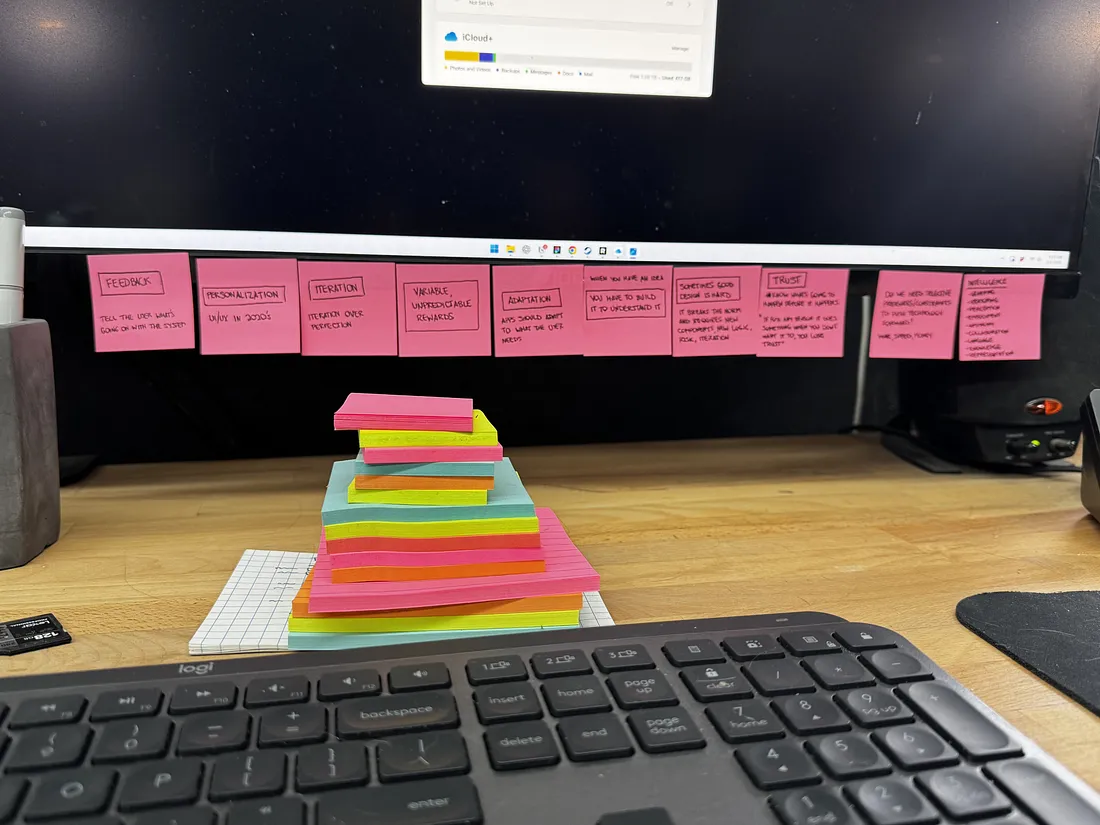
1. Feedback
Feedback is critical. Just like the relationships that we keep with the people we love, the institutions we operate in, we need feedback. Are we doing a good job? What’s working? What isn’t? When I hit this button, what will happen? It’s helpful sometimes to think about UI as a conversation between a user and the system and in this way, we can draw in many of the principles of effective communication from social psychology and even therapy.
It’s the job of the designer to create parity between the state of the product and the state of the user to align expectations and outcomes. This plays out in ways large and small and represents a
Of the 23 components in Google’s Material 3 Design kit for example, 8 are devoted to feedback directly, while the remainder often use states to communicate intent.
(those are badges, checkboxes, dialogs, progress indicators, radio buttons, switches, snackbars, and tooltips)
2. Personalization
I’m imagining a future where app states and entire layouts are determined by factors referencing a user’s lived experience has an effect. I’m seeing versions of this today already. Website that load differently for returning users versus new users. Spotify and YouTube and any other algorithm-driven app shows you the things you’re more likely to listen, watch, or read.
I’m talking about something a little deeper. Take what you know about how a user uses your app and modify the app itself to show them more of what they want. If someone primarily uses Spotify for audiobooks, make the home page all about audiobooks, give them features that enhance their experience. If someone logs the same breakfast in a nutrition tracking app every day, prompt them if they want to log it when they open the app in the morning, saving them time. There’s so many ways apps can take data about how the user is using your app and making the user experience better as a result. I think this will continue to take off in the latter half of the 2020’s and beyond as machine learning and AI becomes cheaper, more accessible, and more ubiquitous.
It also generates this sentiment of “damn, they’re really thinking about what I’m doing” and I think that goes a long way to building trust (more on that below)
3. Iteration
Nothing too profound here, but I find that too often I’m trying to nail something on the first try rather than realizing that every major product and app was worse than it is today in the past and will be better than it is today in the future.
Iteration is how we get there. We make a thing, we improve it. We improve it again and so on. We’re great at this as humans, and I have to stop chasing perfection quite as often while continuing to do my best work as often of the time as I can.
4. Variable, unpredictable rewards
One of the great insights behind gambling addiction, loot crates in video games, and why social media is so difficult to stop using ties directly into brain chemistry. It’s being (1) being rewarded, (2) it’s variable (sometimes high, sometimes low, sometimes nothing), and (3) it’s unpredictable (sometimes you expect a certain outcome but the reward seems unlinked or disproportionate).
These things keep you coming back. How can we use this as a force for good? Can we promote behaviors that make for healthier users more of the time by paying attention to what users are doing and responding accordingly?
5. You have to build it to understand it
This guy makes a visualization to get users to think more about the true nature of reality. The end product is great, but it’s his thought process that stood out to me. And he’s right: to understand something, you have to make it. We have to tinker, we are tinkerers. We can only theorize so much of the time before we have to do, make, break, iterate, scrap ideas and so on.
6. Sometimes good design is hard
I think about Apple a lot. I have way too many screenshots in my camera roll of specific ways they’ve designed an interaction. Some of them are standard, some of them blow me away. I think it takes courage, risk and iteration to try new things. (Plus usability testing, time, and a robust and well-functioning team, but that’s a given.)
This is just a reminder to me that standard components are great and oftentimes new designers are encouraged not to reinvent the wheel whenever possible. (You dumb pleb, haven’t you realized that other designers have already solved this problem? Pay your respects first.) I think this actually isn’t great advice. If we really do learn by doing, I think we should try new things, often. We all benefit from casting the widest possible net of ideas, so long as we have a good way of whittling down to the good ideas in the end.
I think it stifles innovation when designers are encouraged to stay safe.
Or think about it this way: how do we come to have a floating action button? Someone realized there was a need and created this entirely new thing. That could be you! Or me! We could be creating the interfaces of 2030 and 2040 that involve brand new ways of interacting with our digital spaces.
Last thing here. The scroll bar is only 40 years old. The search bar is only 30 years old. Swipe and pinch gestures have only been around for 18 years. The computer icon is only 50 years old. Let’s get creative here.
7. Trust
Basic UX here, but users need to know what is going to happen before it happens. Trust is one of those carryovers from human to human relationships to human-computer relationships. And cheers to Yves Behar in User Friendly: How the hidden rules of design are changing the way we live, work, and play for saying it succinctly, “If for any reason [the product] does something when you don’t want it to, you lose trust”
8. Selective pressures
With the AI advancements these days that seem progress at a dizzying pace, I’ve been linking some ideas together about how technological progress is made, about how we make new and better things.
In evolutionary theory, it’s often that some quality of an environment forces a species through mutation, reproduction and sheer numbers to solve a particular problem. The main problem is “don’t die”, but it’s how we have eyeballs, why tendons exist, opposable thumbs, circulatory systems, why I can never swat a fly when I want to (they react anywhere from 5 to 12.5 times faster than we do).
It’s pressure, we need pressure.
War is a pressure, making money is a pressure, limited resources is a pressure. Do we need pressure to push progress and truly innovate? That’s a question I’ve been thinking about lately. Some of the most important discoveries to ever happen to technology have come from wartime including breakthroughs in cryptography, computing, storage, interaction, AI, materials science and literally every major category of technology.
I don’t want war to be the main pressure that drives progress. So maybe it’ll leave it there.
Further reading/watching:
8 Things I'm thinking about lately in interface theory
12 min read
While I’m quite early along in my own user journey in the UI/UX field, a background in philosophy, a critical eye on technology, and an armchair interest in various intersections with psychology and science for the last two decades have given me plenty of time to simmer over ideas. Here’s nine things I’ve been thinking about lately thanks to wonder people sharing good work. You can go check out the sources for yourself at the bottom for added context and a broader understanding.
While I’m quite early along in my own user journey in the UI/UX field, a background in philosophy, a critical eye on technology, and an armchair interest in various intersections with psychology and science for the last two decades have given me plenty of time to simmer over ideas. Here’s nine things I’ve been thinking about lately thanks to wonder people sharing good work. You can go check out the sources for yourself at the bottom for added context and a broader understanding.
1. Feedback
Feedback is critical. Just like the relationships that we keep with the people we love, the institutions we operate in, we need feedback. Are we doing a good job? What’s working? What isn’t? When I hit this button, what will happen? It’s helpful sometimes to think about UI as a conversation between a user and the system and in this way, we can draw in many of the principles of effective communication from social psychology and even therapy.
It’s the job of the designer to create parity between the state of the product and the state of the user to align expectations and outcomes. This plays out in ways large and small and represents a
Of the 23 components in Google’s Material 3 Design kit for example, 8 are devoted to feedback directly, while the remainder often use states to communicate intent.
(those are badges, checkboxes, dialogs, progress indicators, radio buttons, switches, snackbars, and tooltips)
2. Personalization
I’m imagining a future where app states and entire layouts are determined by factors referencing a user’s lived experience has an effect. I’m seeing versions of this today already. Website that load differently for returning users versus new users. Spotify and YouTube and any other algorithm-driven app shows you the things you’re more likely to listen, watch, or read.
I’m talking about something a little deeper. Take what you know about how a user uses your app and modify the app itself to show them more of what they want. If someone primarily uses Spotify for audiobooks, make the home page all about audiobooks, give them features that enhance their experience. If someone logs the same breakfast in a nutrition tracking app every day, prompt them if they want to log it when they open the app in the morning, saving them time. There’s so many ways apps can take data about how the user is using your app and making the user experience better as a result. I think this will continue to take off in the latter half of the 2020’s and beyond as machine learning and AI becomes cheaper, more accessible, and more ubiquitous.
It also generates this sentiment of “damn, they’re really thinking about what I’m doing” and I think that goes a long way to building trust (more on that below)
3. Iteration
Nothing too profound here, but I find that too often I’m trying to nail something on the first try rather than realizing that every major product and app was worse than it is today in the past and will be better than it is today in the future.
Iteration is how we get there. We make a thing, we improve it. We improve it again and so on. We’re great at this as humans, and I have to stop chasing perfection quite as often while continuing to do my best work as often of the time as I can.
4. Variable, unpredictable rewards
One of the great insights behind gambling addiction, loot crates in video games, and why social media is so difficult to stop using ties directly into brain chemistry. It’s being (1) being rewarded, (2) it’s variable (sometimes high, sometimes low, sometimes nothing), and (3) it’s unpredictable (sometimes you expect a certain outcome but the reward seems unlinked or disproportionate).
These things keep you coming back. How can we use this as a force for good? Can we promote behaviors that make for healthier users more of the time by paying attention to what users are doing and responding accordingly?
5. You have to build it to understand it
This guy makes a visualization to get users to think more about the true nature of reality. The end product is great, but it’s his thought process that stood out to me. And he’s right: to understand something, you have to make it. We have to tinker, we are tinkerers. We can only theorize so much of the time before we have to do, make, break, iterate, scrap ideas and so on.
6. Sometimes good design is hard
I think about Apple a lot. I have way too many screenshots in my camera roll of specific ways they’ve designed an interaction. Some of them are standard, some of them blow me away. I think it takes courage, risk and iteration to try new things. (Plus usability testing, time, and a robust and well-functioning team, but that’s a given.)
This is just a reminder to me that standard components are great and oftentimes new designers are encouraged not to reinvent the wheel whenever possible. (You dumb pleb, haven’t you realized that other designers have already solved this problem? Pay your respects first.) I think this actually isn’t great advice. If we really do learn by doing, I think we should try new things, often. We all benefit from casting the widest possible net of ideas, so long as we have a good way of whittling down to the good ideas in the end.
I think it stifles innovation when designers are encouraged to stay safe.
Or think about it this way: how do we come to have a floating action button? Someone realized there was a need and created this entirely new thing. That could be you! Or me! We could be creating the interfaces of 2030 and 2040 that involve brand new ways of interacting with our digital spaces.
Last thing here. The scroll bar is only 40 years old. The search bar is only 30 years old. Swipe and pinch gestures have only been around for 18 years. The computer icon is only 50 years old. Let’s get creative here.
7. Trust
Basic UX here, but users need to know what is going to happen before it happens. Trust is one of those carryovers from human to human relationships to human-computer relationships. And cheers to Yves Behar in User Friendly: How the hidden rules of design are changing the way we live, work, and play for saying it succinctly, “If for any reason [the product] does something when you don’t want it to, you lose trust”
8. Selective pressures
With the AI advancements these days that seem progress at a dizzying pace, I’ve been linking some ideas together about how technological progress is made, about how we make new and better things.
In evolutionary theory, it’s often that some quality of an environment forces a species through mutation, reproduction and sheer numbers to solve a particular problem. The main problem is “don’t die”, but it’s how we have eyeballs, why tendons exist, opposable thumbs, circulatory systems, why I can never swat a fly when I want to (they react anywhere from 5 to 12.5 times faster than we do).
It’s pressure, we need pressure.
War is a pressure, making money is a pressure, limited resources is a pressure. Do we need pressure to push progress and truly innovate? That’s a question I’ve been thinking about lately. Some of the most important discoveries to ever happen to technology have come from wartime including breakthroughs in cryptography, computing, storage, interaction, AI, materials science and literally every major category of technology.
I don’t want war to be the main pressure that drives progress. So maybe it’ll leave it there.